The first day ended with us eating sushi and enjoying a late evening walk along the lake-front with the clouds still shrouding the hills. Exhausted, after such a long day of travelling, we fell into a dead sleep by 9pm and didn’t move until just after 5, when we started to hear movement outside.
We’re early risers, so weren’t worried and after lying in bed for a short time, watching the light start to leak around the edges of the blinds, we got up, threw on some clothes and went out to see what was happening.
The cloud of the night before had disappeared and the lake was reflecting the gloriously soft, morning light. We suddenly appreciated what a beautiful place we had decided to stay in.

The lake was skirted by steep, wooded banks that fell into the water, layers and folds of mountains into the distance, the low light deepening the shadows.
The lake itself was already busy with fishermen, some on the bank, but many out on the water in little boats, their reflections shimmering across the surface. It was tranquil, and almost timeless in its simplicity.
There were kingfishers (more than I have ever seen before) darting between the jetties & bullrushes, finding suitable spots to sit and fish. And we watched as huge carp swam slowly through the shallows, just in front of us, sending the smaller ones darting away.
We took our mugs and wandered along to sit on the bank, where we realised that towering above the view was Mount Fuji. It’s dramatic shape and blunt summit so distinctive against the rounded, softer angles of the ones near the lake.

Yesterday, when we arrived, we had no idea that we would be able to see it from here, so to have it in our morning view was just a joy, and we sat watching the day begin surrounded by such incredible beauty.
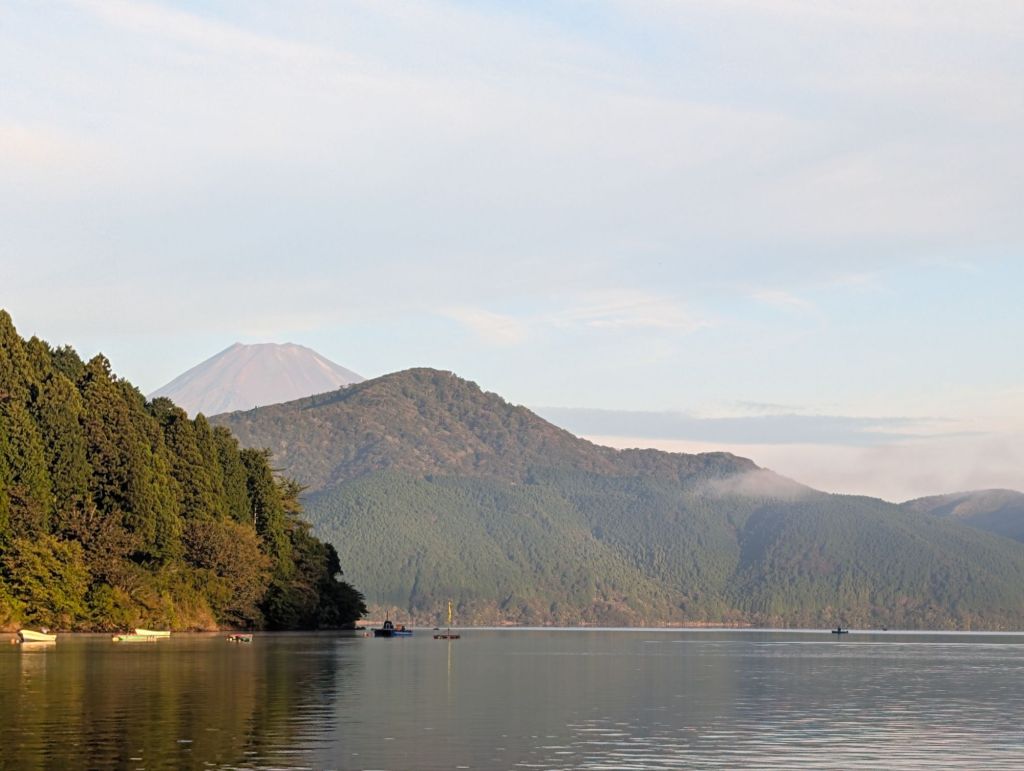
As we sat, we made plans for the day. We realised that even after a good night’s sleep, we were tired and thought we would just take a short walk out along the lakeside path, coming back through the woods and then pottering to a local onsen in the afternoon for a nice shower and a soak.
So after breakfast, we put some snacks & drinks in the rucksack and headed out, following a route I’d found on Komoot, which led out of Hakone, along the banks of the lake. It wasn’t long before our plan changed.
As we left Hakone, we stumbled across our first shrine. The Tori gate on the road led to a peaceful wooded glade with a shrine to 2 dogs.
From what we understood, when the village was founded in 1618, there were large numbers of wolves that caused problems for the people living there whilst construction was taking place. Two Chinese dogs were brought into the village to kill the wolves, and after that the Post Town was successfully completed. Unfortunately, the dogs were injured too and died as a result of their wounds.
The villagers were so grateful for their efforts that had enabled them to complete the construction of the village, that they buried them and worshiped them as ‘Inuzuka Myojin’
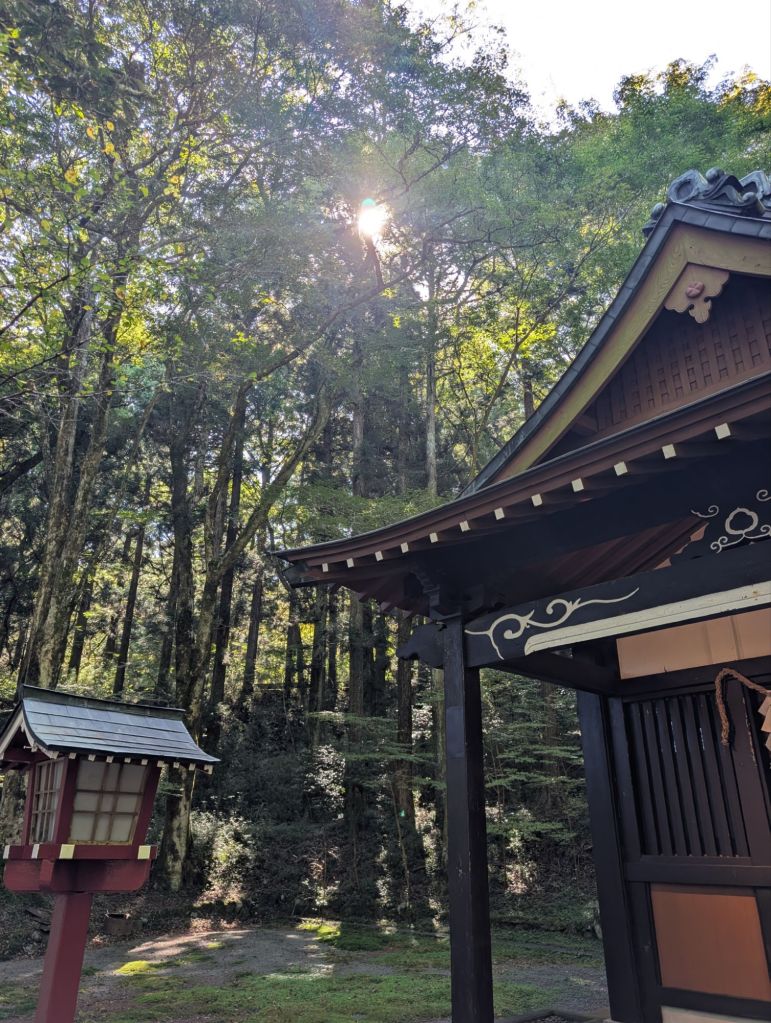
A lovely first experience of a Japanese Shrine for us, so we rang the bell to get the attention of the gods, left a gift, bowed and backed away, before continuing on.
The path took us along the lakeside, taking a rough road, which then turned into a track, following the lake’s shoreline as we headed off, for what we still thought would be a short walk, and a generally calm day.
But within a kilometre, our plans changed. The walk was just what we needed, and we realised that we could walk the length of Lake Ashi, to Togendai Station, where we would be able to catch one of the ‘galleons’ back to Hakone. We couldn’t imagine a better way to pass the day, and boot a bit of the jet-lag out of our system.
Everything around us was different. The trees ranged from arrow-straight pine trees, with networks of roots that made us stumble as we walked. There were also the Japanese Acers, their delicate leaves starting to show the first signs of the end of summer, and so many others that I didn’t recognise at all!

The birdsong too was different. Yes there were some that we recognised, but many that were totally new to us. We tried using the wonderful Merlin App, having downloaded the Japan pack before we left, but unfortunately, it couldnt help either. However, it did allow us to recognise the call of the wonderfully named ‘brown-eared bulbul’ and the equally elaborate ‘red-billed leiothrix’, which rather made our day. Certainly very different to ‘robin’ and ‘blackbird’
With every step, our brains felt clearer and the kilometres disappeared under our feet. In places the path had been destroyed by heavy rains, with crossing points having been washed away, leaving us climbing slowly down into little gullies, before heaving ourselves back out again.
The path at times was almost hidden by the growth of bamboo, which shielded our view of the lake, but was happily stopping the path slipping down the bank into it too.
At one point, the path opened up and we were able to walk through to the lake, sitting on an old log, watching the fish jump and admiring the views across the water.
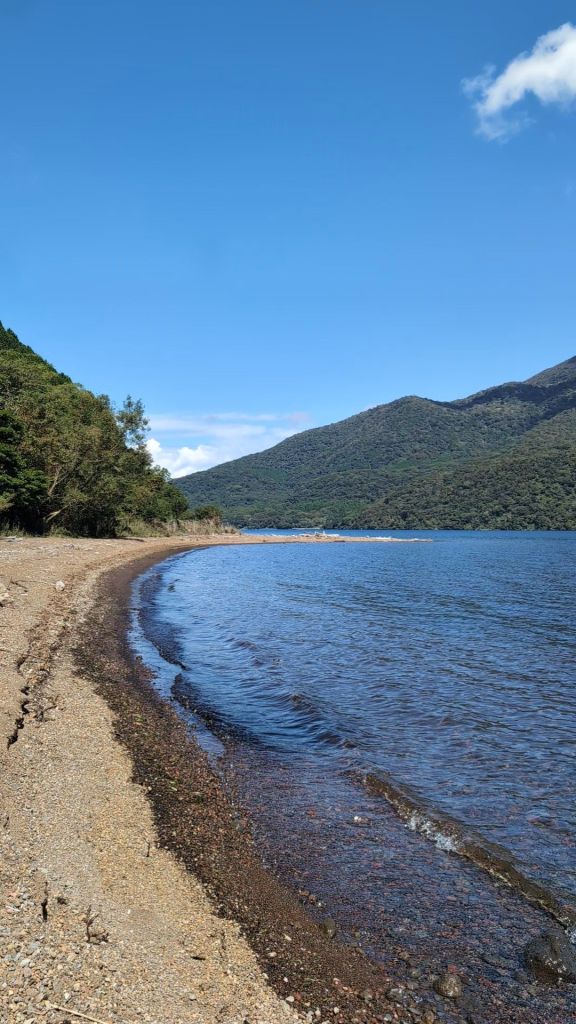
We ambled on, just enjoying the absolute peace of being away from any man-made noise at all. Even where we are in Provence, that isn’t always easy to find. It was such a treat.
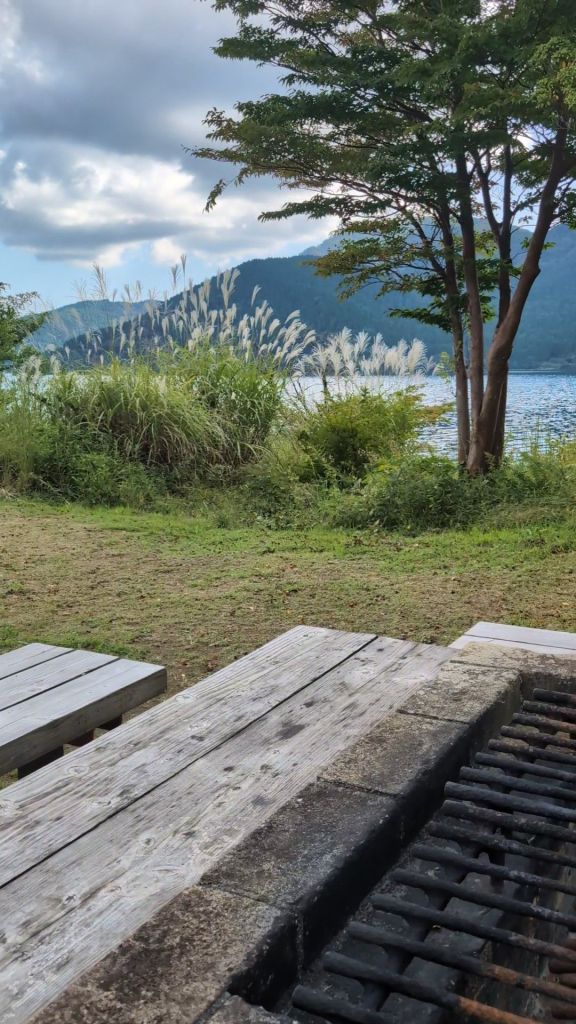
Eventually, we arrived in Togendai Station, and stopped for some lunch, watching the water and a cloud of dragonflies that were darting around, above us. We had noticed a cable-car running out of the village, so took a look at where it went.
This sent our day in yet another direction, as we found that it went to a volcanic site called Owakudani, which is known as ‘The Valley of Hell’ and renowned for its ‘black eggs’, which are cooked in sulphurous water for 60 mins before being steamed. Their shells are black, and it’s rumoured that eating them can add years to your life!
So clearly, we couldn’t miss the opportunity to take a trip in the cable-car to visit this amazing place. Our day was turning into quite an adventure.
We went to the station, purchased 2 return tickets for the trip, (7000 Yen = £35) and 2 tickets for the boat trip back to Hakone too (2400 Yen = £12), and joined the queue for the ride up to the Valley of Hell.

We sat in the gondola and were swept up the mountainside, with glorious views back down to the lake and across the hills towards banks of clouds that were shrouding Mount Fuji, after its morning appearance. I’m sure that on a clear day, the views must be absolutely breathtaking.
As we passed through Ubako Station, the cable car route took a right turn and we got a first sight of the plumes of sulphurous steam rising from vents in the mountainside.
All the trees had been stripped of their leaves, with the only greenery being from the low-growing shrubs and brush. Even now, we caught the scent of the steam in our noses.
Arriving in Owakudani, it’s easy to see why it has gained its nickname. The side of the mountain has collapsed and is a scree and rock bank, supported with retaining walls in places. although even these are showing signs of collapse in some places.

Anything that has previously grown on the slope is long-since dead and in various places, plumes of evil-smelling steam were rising into the air and drifting away in the breeze.
The areas around the vents were yellow with heavy deposits of sulphur and it looked like a scene from a disaster movie.
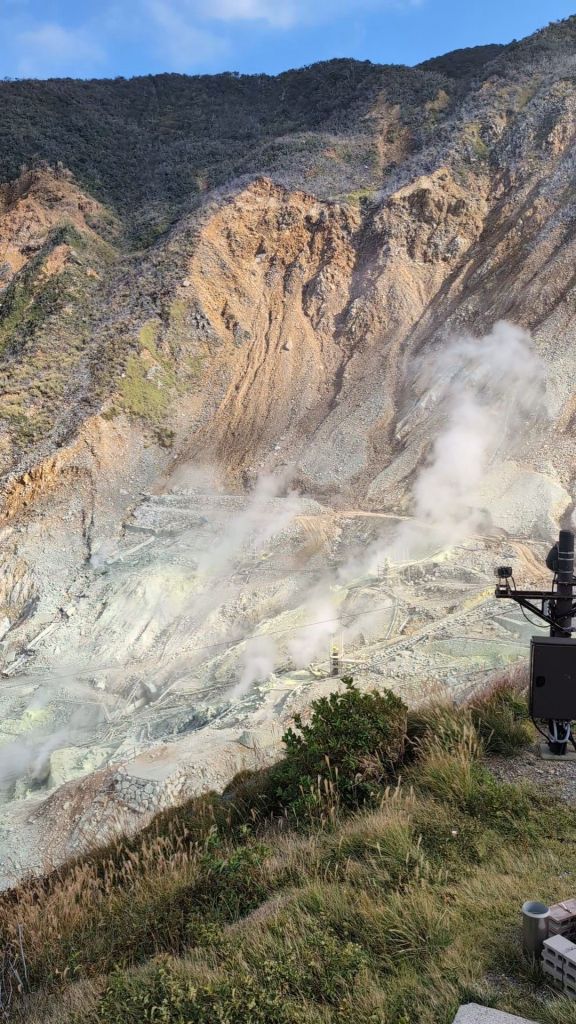
It’s still an incredibly active valcanic site, having been formed approximately 3000 years ago, with the most recent eruption being in 2015.
It is a vast site and there are well-built viewing platforms that, in one place, allow you to walk out, over the landscape on a glass floor. Not for the faint-hearted, which included a chihuahua that refused point-blank to take even the slightest step onto it.

It is an incredible sight and was certainly worth the trip up, and it was nice to sweep back down again, over the long queue of cars, waiting to park there .
Once down, all we had left to do was to catch the ‘galleon’ back to Hakone. These ferries are quite a sight. Who needs a modern, white ferry, when you can take the trip in one that has been designed to resemble a masted warship, or even a pirate ship, both inside and out. They even have gold-painted figureheads…
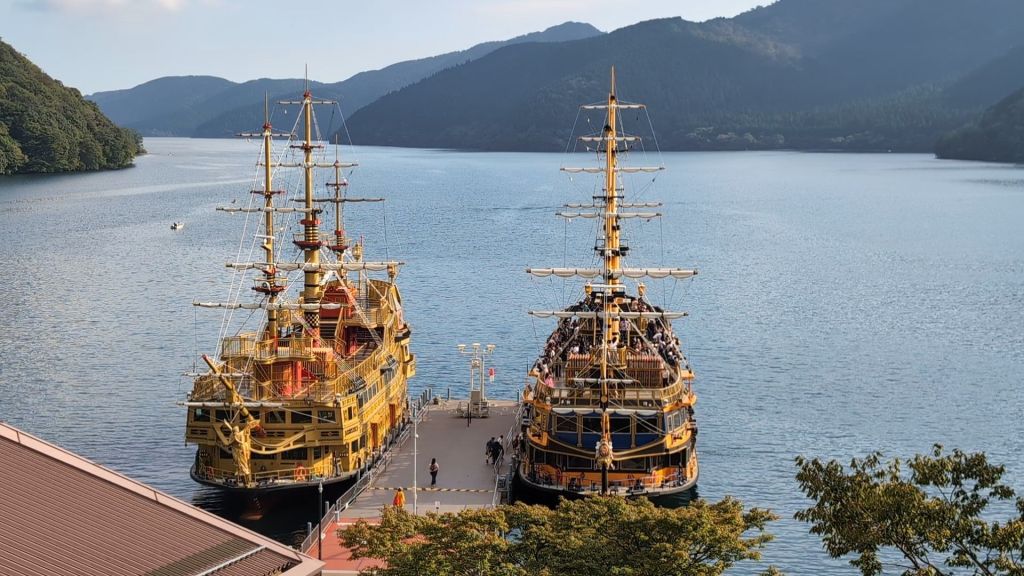
It’s quite surreal watching them making their way up and down the lake, but having walked out to the far end, we didn’t fancy walking all the way back again too.
As we went back, there was a guide pointing out the sights as we passed and in a short time, we docked in Hakone at the end of what had been a much busier day than we had expected.
Once back, we had our first experience of visiting a laundry, which proved to be a very easy process. As we left the clothes to wash, we walked back down to the lake and watched the sun start to settle below the hills.

As it started to drop, the clouds began to melt away and Mount Fuji emerged again, glowing in the pink and apricot tones of the evening sky.

It was breathtaking and all we could do was sit and watch it, absorbed by the beauty. It was only as the colours started to fade that a young woman approached to say that she had taken our photo, whist we were on the bench, and offered to send it to us.
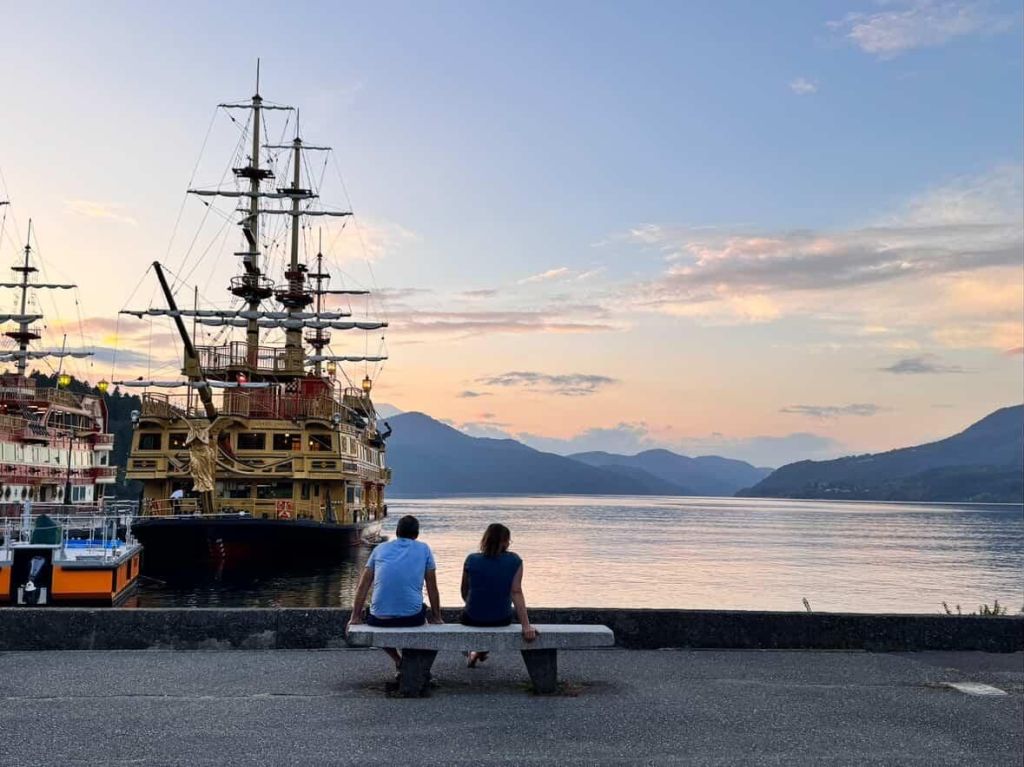
It’s rather beautiful and sums up what a calm, tranquil and utterly stunning place we have visited. What a wonderful first couple of days we’ve had.
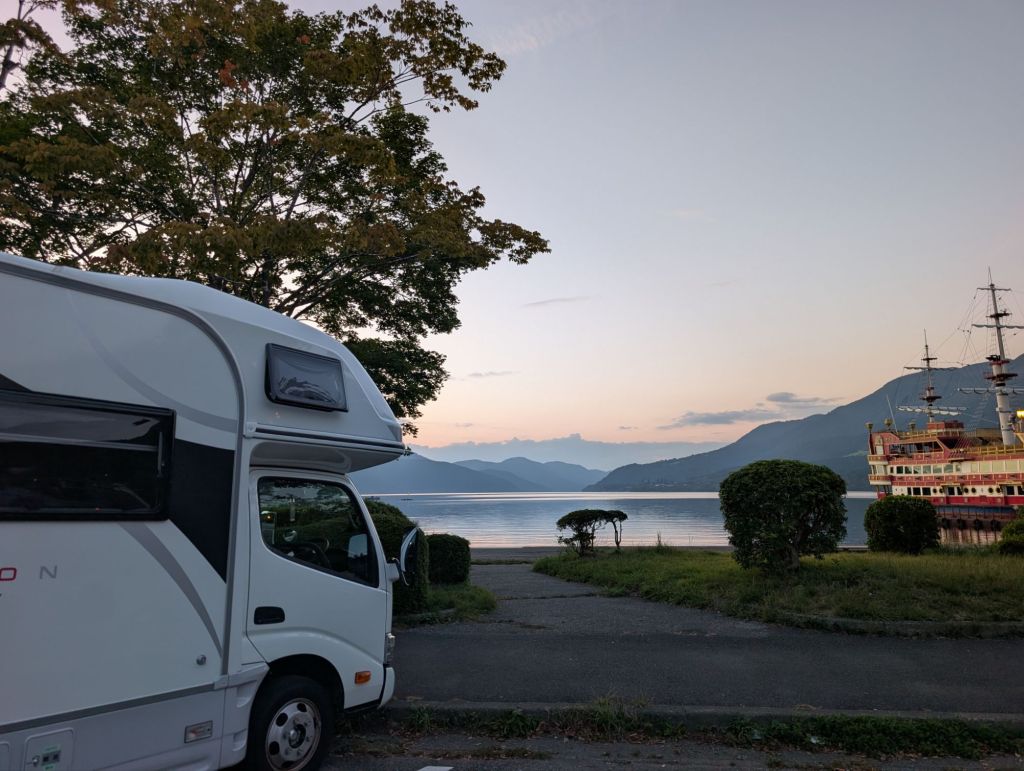
We’re certainly looking forward to the next 40!


Fabulous! Wh
LikeLiked by 1 person
I think the comment broke off? As all I can see is ‘Fabulous wh’
LikeLike
Hi Julie,Sorry about that. It should read. Fabulous. Wh
LikeLike
Still only as far as wh ?
LikeLike