I’m not known for following advertising links on Instagram. Normally, I’m bombarded with adverts for wall pilates, hormone balancers and women’s cycle clothing (so I suppose it could be worse), but a few weeks ago, a promoted post slipped into my timeline, advertising a candlelight concert of the music of Lord of The Rings and Game of Thrones.
I’m sure that this would have most people swiping on to the next post, but not me. Our youngest son has always loved the Lord of the Rings, he’s devoured Tolkein’s books, and watched the films so many times that he’s pretty much word-perfect and I know the music too. He had just booked leave to come over for a visit, so I had to check if we may be able to get to one of the concerts, whilst he was over.
He had mentioned before about trying to get tickets to watch the film, with a live orchestra, at The Royal Albert Hall, but this hadn’t happened, so perhaps this would fill a little gap.
When I followed the link to the advert, I found that there were many to choose from. The company organises candlelight concerts across France, and we could have seen music by Queen, Abba, Vivaldi, Coldplay and Hans Zimmer (another favourite), but nothing leapt out locally for the Lord of the Rings & Game of Thrones, whilst he was here. Visit the website here
Then I found one, not exactly a 2 minute drive up the road, but there was one scheduled for 10 pm, the day after he arrived, on the rooftop of the Musée de la Romanité in the heart of Nimes.
10pm! That’s bedtime for us, and Nimes is just under 2 hrs drive away, but it was too good an option to miss, so I took the plunge, booked the tickets and we started to look forward to the evening
Ridiculously, we have passed through Nimes many times over the years, but have never been into the city to visit any of the Roman sites there, so it was the perfect opportunity to tick this off the list, especially as he’s passionate about history too.
So on Sunday afternoon, we hopped in the car and drove across to the city, parking in one of the central car parks and walking out into the main plaza, outside the magnificent Arena.
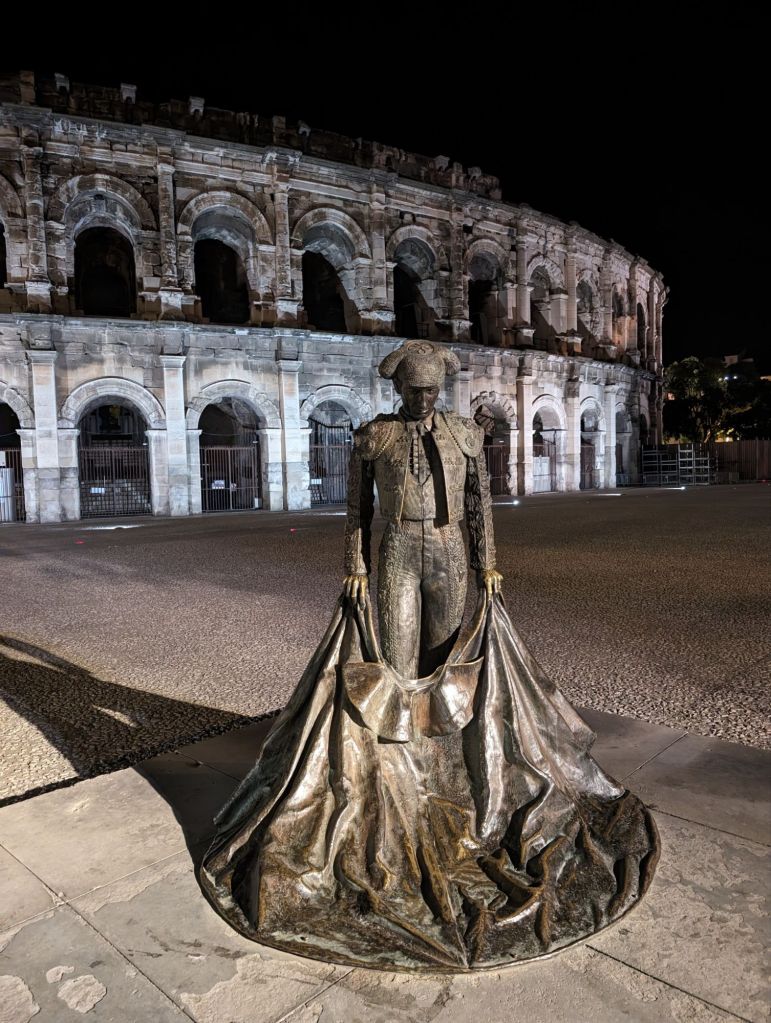
The Arena in Nimes is a spectacular sight, set in the centre of the city, on the edge of the warren of narrow old streets. Whereas the arena in Arles is surrounded by buildings, this stands proud, in isolation and in some ways is more similar to the Colosseum, in that respect.
It is incredibly well-preserved and we bought tickets and went to take a look around. Once inside, we wandered around the atmospheric structure, using the audio-guide that we had collected on the way in.
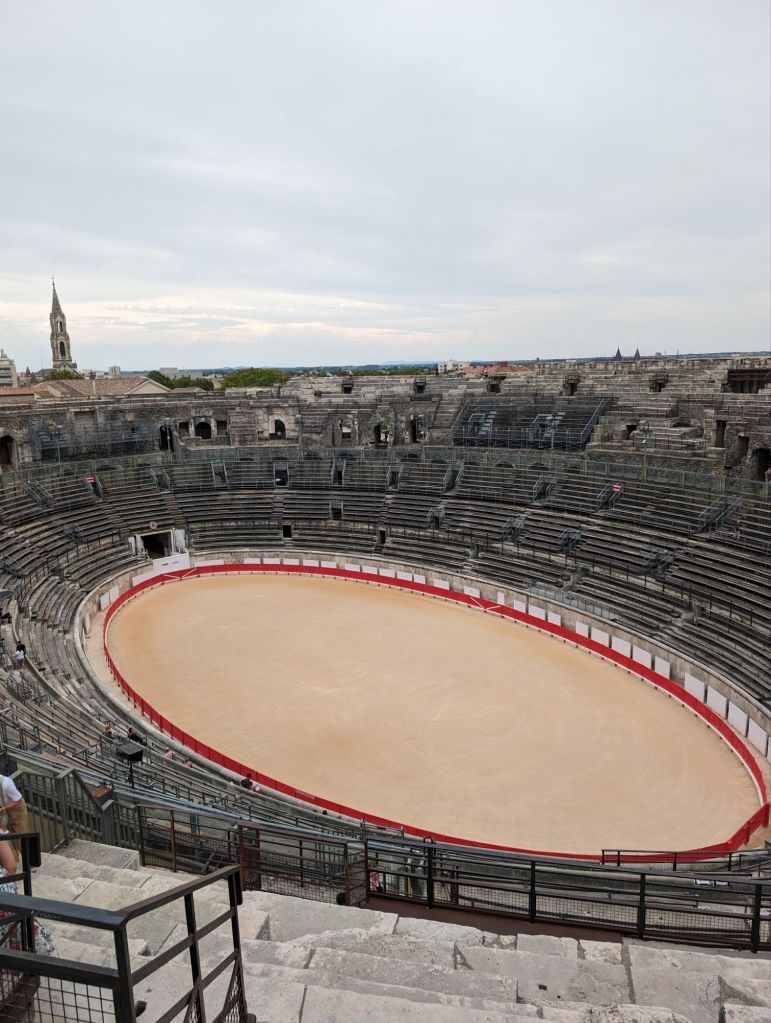
Out of the (over 400) amphitheatres still in existence, it is in the top 20 and at its height would have held 24,000 spectators, who came to watch the events that were held there.
In the Roman era, the area around Nimes was wooded, and some of the attractions held at the Arena (if you can call it an attraction) were fights between local wild animals found in the woodland, that were chained together.
There were also the Gladiators, who fought each other in combat, to the delight of the crowd. These highly trained individuals were brought to life by the information on panels around the stadium and also in the small Gladiators’ dressing room, where there were examples of their ‘armour’ and weapons too.
To be honest, I found this fascinating, as I had always thought that all Gladiators were the same, but realised that couldn’t be further from the truth.
There were named groups, each having different attributes and using different armour and weapons. There were the Secutors, who simply carried a short sword, wearing protection on their right arm and left leg, carrying a curved rectangular shield. They also wore a helmet, with unusual eye protection, to protect themselves from the unusual weapon, used by their normal adversary, the Retiarius.
The Retiarius, was a much more lightly armoured Gladiator, who simply wore an arm and shoulder guard as protection. They were equipped with a weighted net and a trident, together with a dagger. They had to be nimble of foot and use everything in their power to trap either the weapon or the whole opponent with his net, to disable them, before attacking with the trident.
So much for my simple thinking that all were effectively the same.
As we explored the highest of the stone seats, it was easy to have a sense of the atmosphere that there must have been in the arena, when it was packed with a vociferous Roman crowd. The view of the floor from even the highest set of seats was amazing and the sound from people walking around the lower levels was easy to hear. It must have been like being in a fierce cauldron of sound.
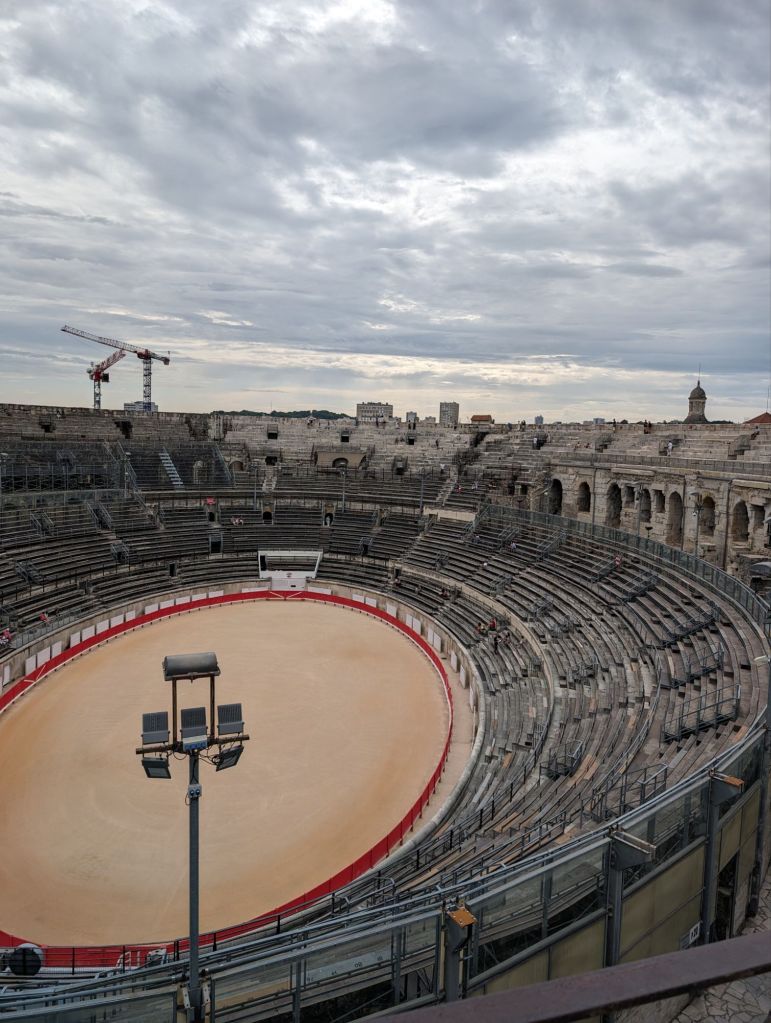
Like many of today’s huge stadiums, it also had a roof, not a solid one, but made of fabric, attached to 120 wooden masts, which were fixed into the top of the walls, allowing the fabric sails to be winched out, protecting the crowd.
When the Arena was renovated in the late 1800s, they also found stone galleries, 4 metres below the floor, which would have been equipped with lifts and storage areas, allowing even more excitement and drama to be introduced to the shows.
It really was easy to pass the time in this most fascinating of spaces, intrigued and absorbed by its history, imagining the echoes of the past reverberating around its walls. It is still in use for shows today, with concerts throughout the year, especially during the Festival of Nimes and also bullfighting during the annual Feria.
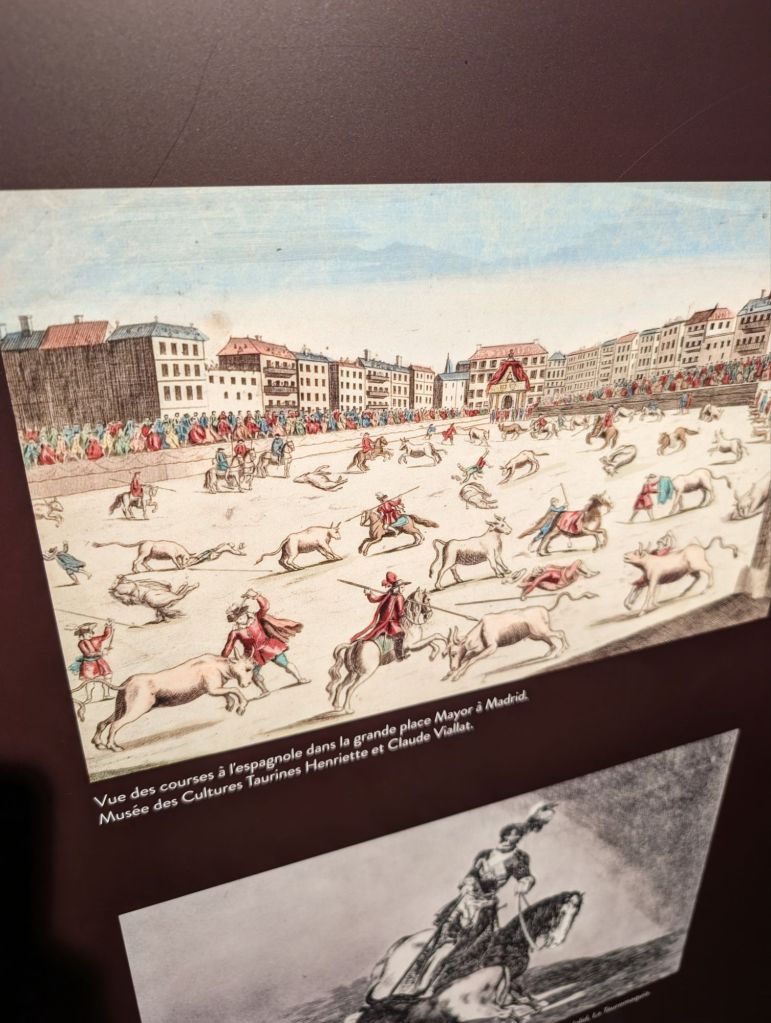
We were a little surprised to see details about bullfighting taking place in the Plaza Mayor in Madrid displayed here too, as we will be staying in an apartment overlooking there on the first couple of nights of our cycle trip, at the end of the month. It felt like one of those ‘small-world’ moments.
Sitting on the highest of the seats, we had a magnificent view across the rooftops of the city, with spires and church towers poking above the terracotta tiles. We also could see the Magne tower, the last standing part of the Roman fortifications that had been built to protect the city.
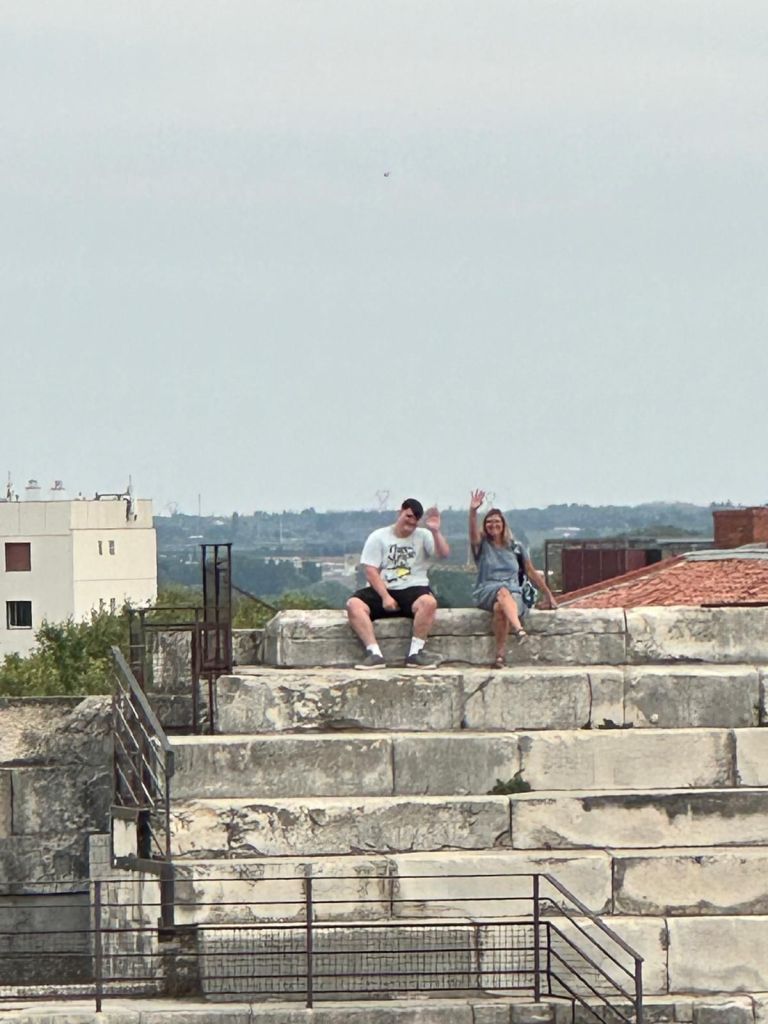
The tower was originally part of the Celtic defences, but was doubled in size by the Romans and is still a prominent point on the landscape today and sits within the ‘fountain gardens’, a beautiful public garden, built around the spring that had been celebrated by the Celts, even before the Romans.
We knew we wouldn’t have a chance to walk up to it during our brief afternoon visit, but perhaps will have a chance to visit this area in the future.
Whilst up on the high level, we also had a chance to look across to the roof of the Musée de la Romanité, which was already covered with candles, ahead of the evening concert.
Our plans of spending time exploring the museum for an hour before supper were foiled. We had read that it was open till 7, but we arrived at 6.01, only to find that the last visitors had just been admitted, with the doors closing at 6. We really shouldn’t have had such a leisurely drink at the café overlooking the Arena, although it had been very pleasant.
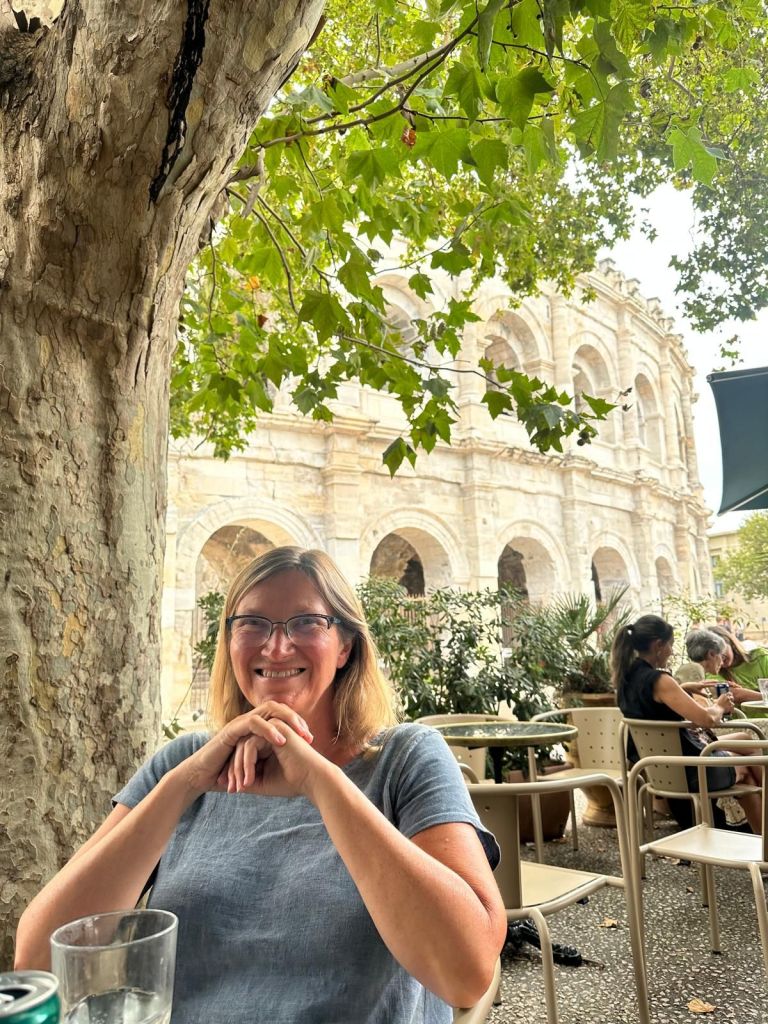
Instead of visiting the museum, we walked through the city to visit the Maison Carré, a beautiful example of a Roman temple, which would have sat in the heart of the Forum. It is one of the best preserved temples in the territory and was dedicated to the Imperial Cult.
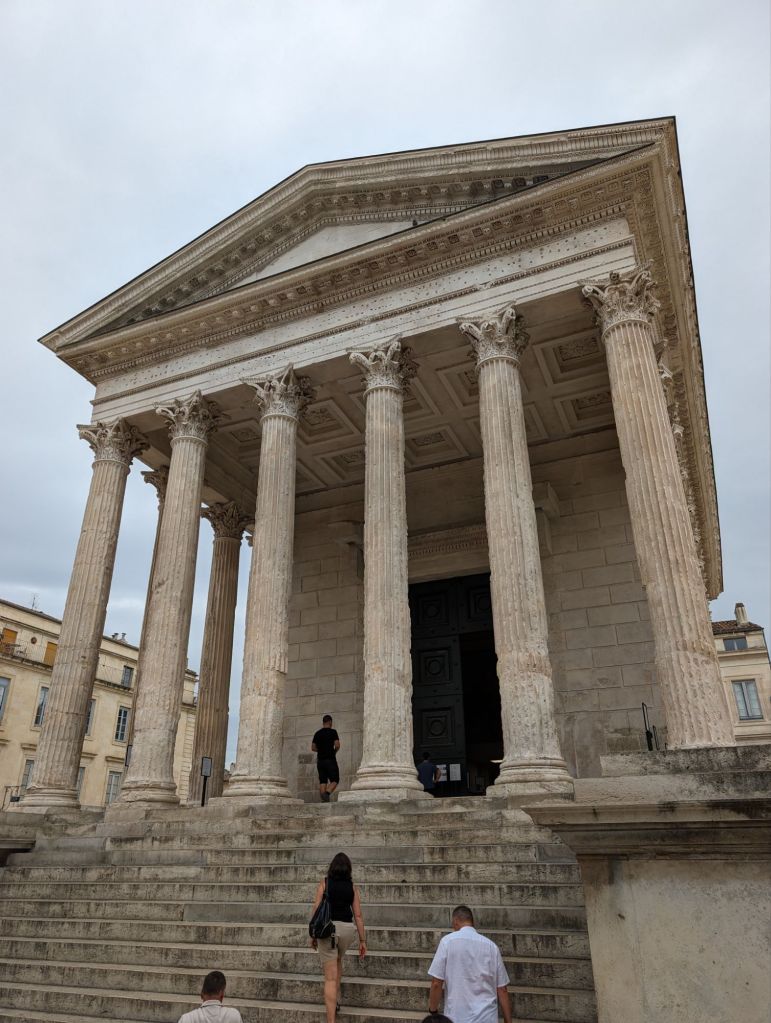
Like the Arena, it has space around it, and there are still parts of the columns that would have formed the Forum set into the ground at the edge of the square.
Wandering back through the streets, on our way for supper, we noticed discs set into the paving, all decorated with a crocodile chained to a palm tree, with a fountain in one of the squares carved in the same form.
This is the symbol of Nimes, and a very striking one it is too, especially as France is not known for its crocodiles. So why here?
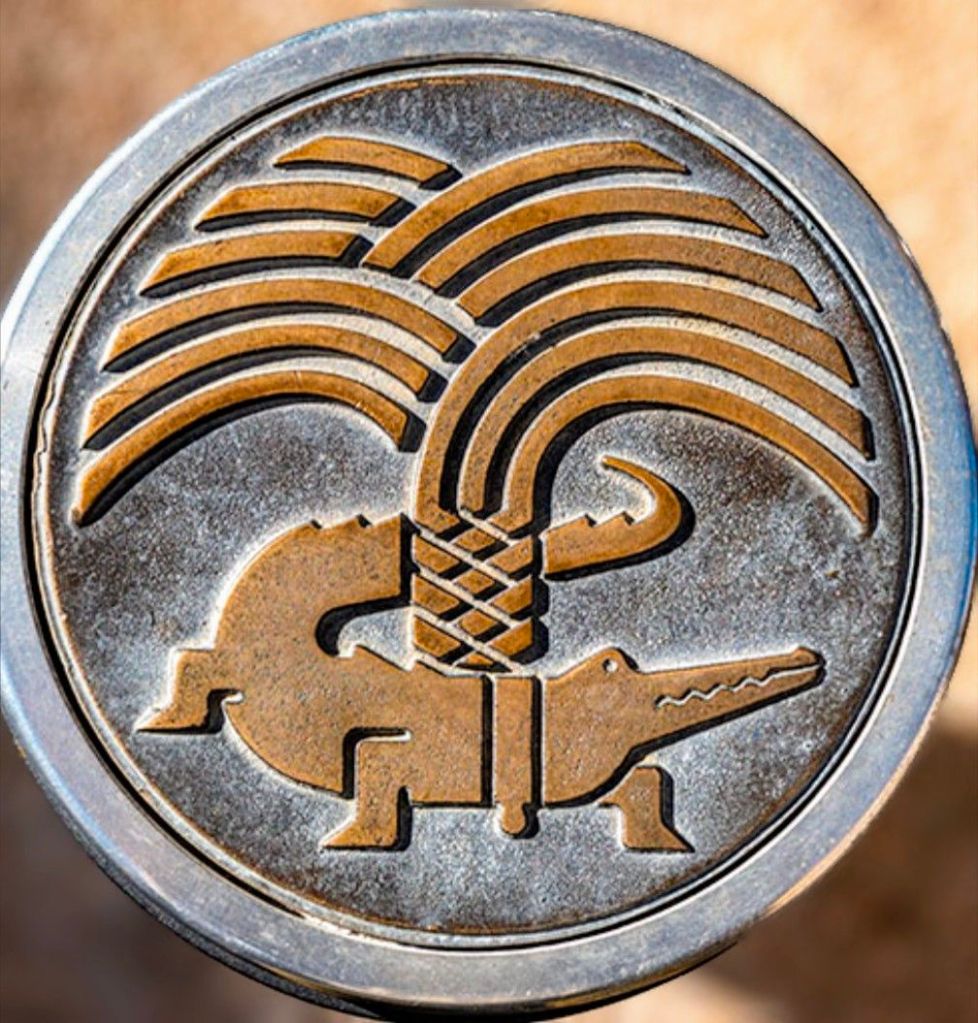
It appears that it dates back to the time when Nimes was a smaller town, before it was really developed by the Romans. In the 1st century BC, the Roman General Octavius defeated Anthony and Cleopatra in Egypt and became Emperor Caesar Augustus. To thank his Legionnaires for their support and efforts, he granted them land that became the city of Nimes. Once there, they struck a coin marked with the symbol of the crocodile chained to the palm to celebrate the victory over Egypt.
It took until 1535 (well over 1500 years of use) for the symbol to be officially declared to be the coat of arms for the city, by King François 1st. It is a lasting symbol of the Roman Empire, which has (as recently as 1986) been updated, when the designer Philip Starck was commissioned to modernise the emblem, which is the one seen across the city in so many different forms.
Anyway, enough of the Romans and onto the concert, which was really why we were there. As we sat on benches outside the Arena, waiting for the door to open, we could see the glow of the candles on the rooftop and caught snatches of music from the earlier concert drifting on the night air.
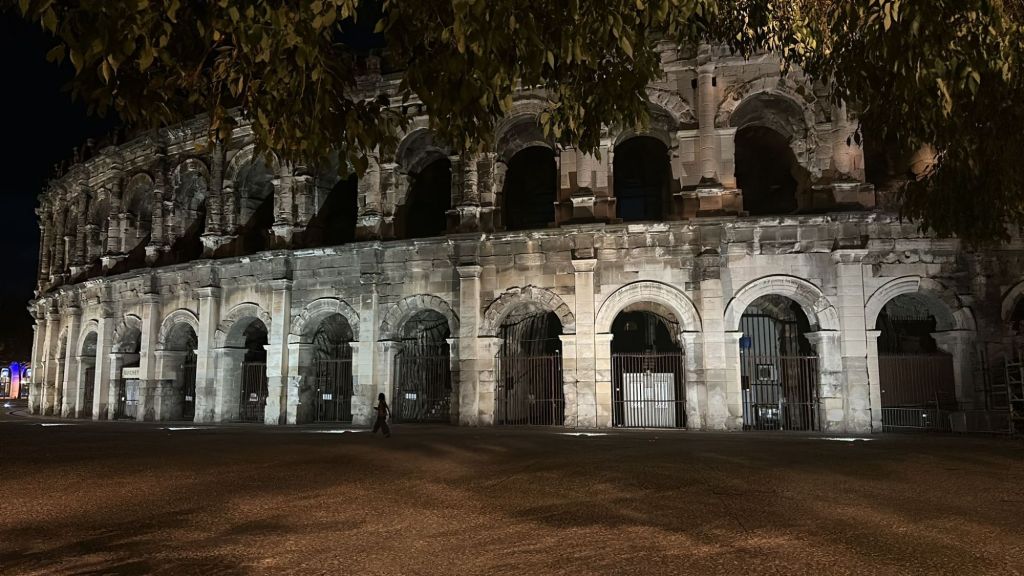
We managed to stay awake, and finally made our way up to the museum rooftop, finding ourselves overlooking the Arena, which was floating on what seemed to be a sea of candles in front of us.
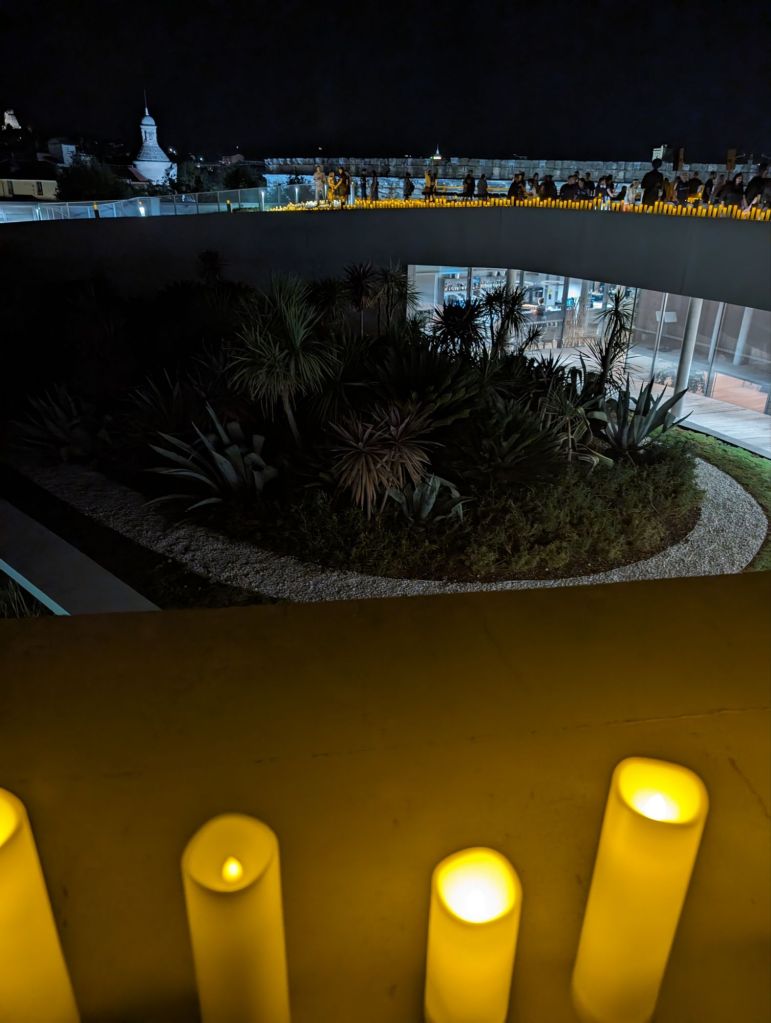
A small stage had been set up, in an intimate setting and after settling down, and being absorbed by the sight of the stars above us, the string quartet took their seats, and introduced themselves.
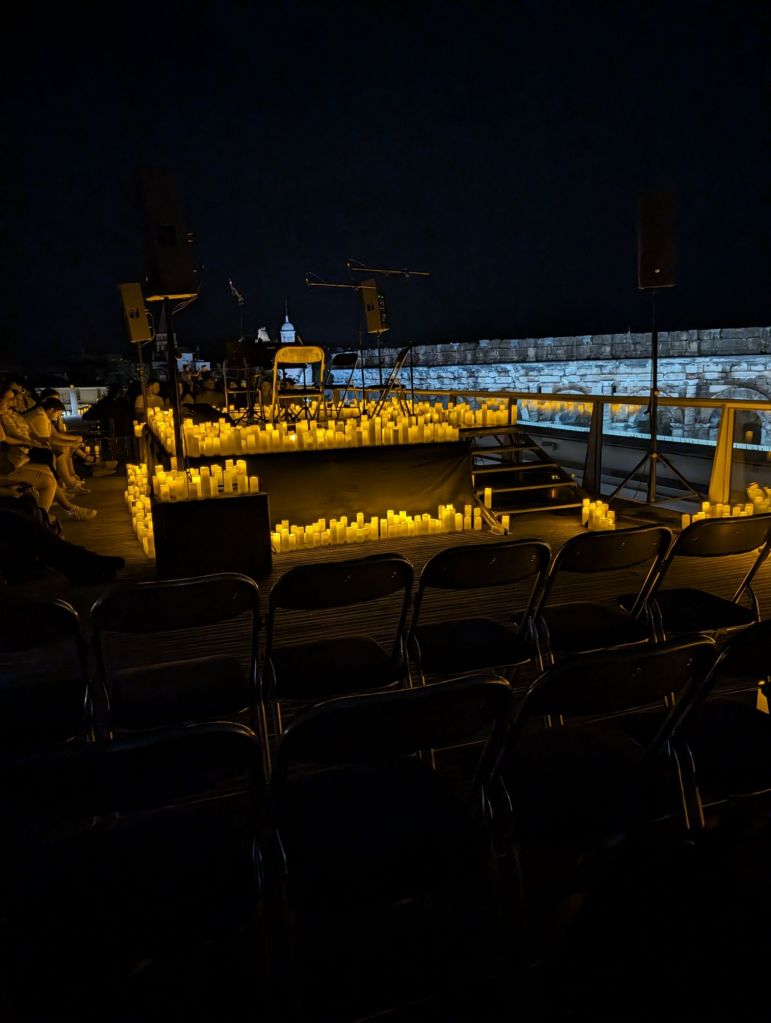
I must admit that at first, I couldn’t imagine how 4 string instruments would be able to capture the power and atmosphere of the music that we had come to hear, but immediately any worries I had floated off into the night.
The talented musicians created a greater range of sound and atmosphere than I had thought possible and within moments I was in The Shire, with the joyful melody filling the sky.
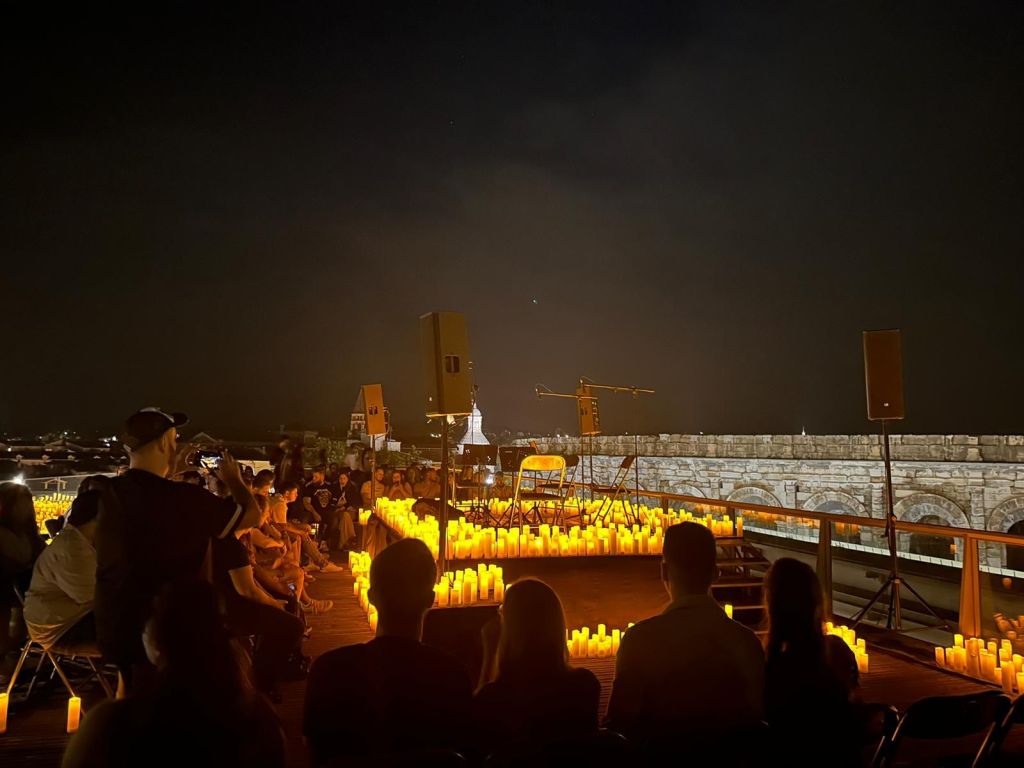
The atmosphere shifted with the music and although I know the films, I hadn’t really appreciated how powerful the music was in creating the story. The soundtracks are always important, framing the story and adding layers of texture to what we see with our eyes. But the music alone was hauntingly beautiful, worthy of being played in its own right and perfectly suited to this intimate event.
As I listened, watching the musicians and the night sky, bats flew above us caught in the golden light of the candles. The concert flew by far too quickly and it seemed as if minutes, not an hour had passed before it was over and the musicians were making their way off the stage.
It had been a superb afternoon and a magical evening too. I’m so glad that I had followed the link from the promoted post on Instagram and wouldn’t hesitate to book another candlelight concert in the future. The Hans Zimmer one may be next.
We may have been a bit exhausted, as we arrived home at just after 1am, but it had been worth it.
 Postcards from Provence and beyond
We’ve seen a couple of these concerts in Nice though not in such splendid settings.
LikeLiked by 1 person
I must admit that the setting really was rather special and the performance was superb… We’ll certainly keep an eye open for another
LikeLiked by 1 person
Love Nime and it sounds like a great way to enjoy the arena. I too wish you would have made it into the new museum, because we have wanted to make it there. Wondering how it compares to the museum in Arles.
Scott
LikeLiked by 1 person
I wonder too, but the boat in Arles really does make that very special
LikeLike